Multi-omics · Statistics · AI/ML · Basic/Translational Science · Drug Discovery
PhD Student · Rutgers University
Institute of Quantitative Biomedicine
01 — About
I am a PhD student at the Institute of Quantitative Biomedicine, Rutgers University, with a multidisciplinary background spanning computational drug discovery, wet-lab biology, and clinical multi-omics integration.
I received my bachelor's degree in Forestry and Wildlife Management, from the Federal University of Agriculture, Abeokuta, where I was introduced to medicinal plants and their traditional therapeutic uses. This exposure to natural product pharmacology shaped my interest in drug discovery and guided my transition into computational biology.
During my master's training, I developed computational chemistry skills — including molecular modeling, molecular dynamics simulations, and density functional theory (DFT) analysis in the labs of Dr. John Determan and Dr. Mette Soendergaard at Western Illinois University — which I applied to screen and characterize bioactive compounds from medicinal plants.
I completed my predoctoral research training in the lab of Dr. Timothy Hla at Boston Children's Hospital, Harvard Medical School, where I investigated sphingolipid metabolism and signaling with a focus on sphingosine, sphingosine-1-phosphate (S1P), and sphingosine kinase 1 enzymatic regulation.
Currently, my PhD research in the lab of Dr. Priyadarshini Kachroo focuses on leveraging multi-omics data — including metabolomics, transcriptomics, epigenomics, and clinical phenotypes — to investigate the biological effects of inhaled corticosteroids (ICS) and uncover molecular factors driving asthma progression in clinical trial populations.
My long-term goal is to contribute to translational science and therapeutic innovation at the interface of data-driven biology and patient-centered medicine.
02 — Research & Projects
My research traverses the boundary between computational and experimental science — from drug screening pipelines to clinical multi-omics integration.
Bioinformatics Pipelines · GitHub
Multi-omics · PhD Research
AI/ML Pipelines · GitHub
Computational Chemistry · Masters
Predoctoral Training in Cell Biology · Harvard Medical School
Multi-omics · PhD Research
Project Overview
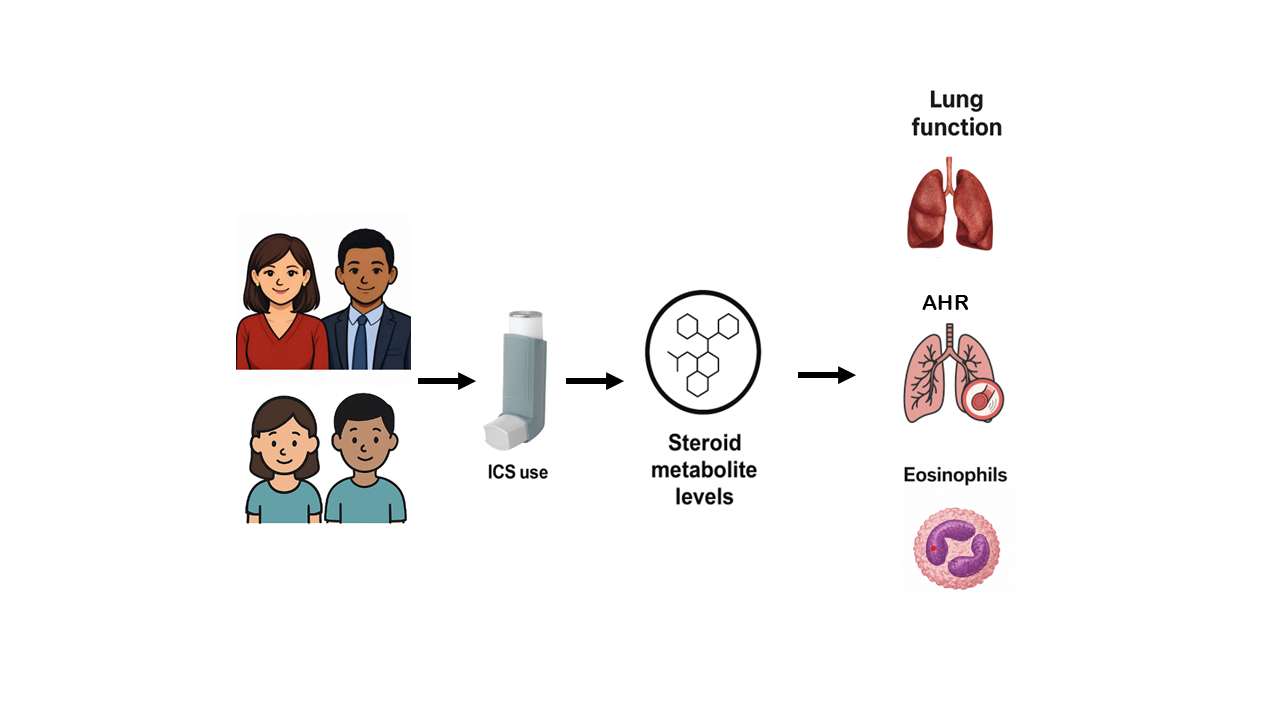
Asthma and responses to inhaled corticosteroids (ICS) can differ between males and females, yet the metabolic mechanisms underlying these differences remain poorly understood. In this study, we used targeted metabolomics to profile 16 endogenous steroid metabolites at baseline and after four years in 664 children with asthma from the Childhood Asthma Management Program (CAMP).
We identified sex-specific metabolic responses to ICS treatment. Males receiving ICS had significantly lower cortisol and cortisone levels at Year 4, while females showed more stable trajectories. ICS also altered relationships between steroid metabolites and key asthma outcomes—including lung function, eosinophils, and airway hyperresponsiveness—in a sex- and pathway-specific manner.
These findings highlight the potential of steroid metabolomics to characterize treatment response and support further investigation of sex-informed approaches to corticosteroid therapy in pediatric asthma.
03 — Conferences
Scientific knowledge is built in community. Below are conferences and symposia where I have presented.
Rutgers School of Health Professions (SHP) Student Research & Scholarship Symposium
Virtual Oral Presentation · New Brunswick, NJ
Rutgers Institute for Infectious & Inflammatory Diseases Annual Research Retreat
Poster Presentation · Newark, NJ
114th ISAS Annual Meeting, Bradley University
Oral Presentation · Peoria, IL
10th Annual Graduate Research Conference, Western Illinois University
Oral Presentation · Macomb, IL
04 — Skills
A cross-disciplinary skill set built over years of work at the intersection of computational and experimental biology.
05 — Interests
Outside of science, music is where I recharge. I enjoy playing classical guitar, particularly the works of Johann Sebastian Bach and Leo Brouwer. When research becomes overwhelming, spending time with the guitar helps me slow down, refocus, and find clarity. There is something deeply rewarding about exploring the structure, emotion, and precision of a well-crafted piece that resonate with me both as a musician and as a scientist.
Classical guitar and scientific research may seem worlds apart, but both are rooted in pattern recognition, discipline, and curiosity. Learning a complex piece of music requires patience, attention to detail, and an appreciation for structure—qualities that are equally important when exploring biological systems and analyzing complex datasets.
06 — Curriculum Vitae
A complete record of my academic training, research experience, publications, and contributions to the scientific community.
Academic Profiles
Google Scholar
ResearchGate
ORCID
07 — Contact
I am open to research collaborations, speaking opportunities, and conversations about science, data, and medicine. Reach out — I read every message.
GitHub
Institution